Thứ Ba, 29 tháng 9, 2015

Chau Doc

Chau Doc
Draped along the banks of the Hau Giang River (Bassac River), Chau Doc sees  many visitors washing through on the river route between Cambodia and Vietnam. A likeable small  town with special Chinese, Cham and Khmer communities, Chau Doc’s cultural diversity – apparent in the mosques, temples, churches and nearby pilgrimage sites –  makes it excellent  to  explore even  ifyou are  not Cambodia-bound. Takinga trip with boat  to the Cham communities across the river is another significance,  when  the  crowded market and intriguing waterfront supply  fine backdrops to some days  of  relaxation.

Sights

30 Thang 4 Park 
(Ð Le Loi) Stretching from the market to the Victoria Chau Doc Hotel, this formal park is the city’s main promenading spot and a superlative spot for river gazing. Sculptures and a fountain are framed by manicured lawns and paths, and if you are eager to get  river-borne, women may approach you here providing  rides in tiny  boats.

Chau Phu Temple BUDDHIST TEMPLE
(Dinh Than Chau Phu; cnr Ð Nguyen Van Thoai & Ð Gia Long) In 1926 this temple was constructed to worship the Nguyen dynasty official Thoai Ngoc Hau, buried at Sam Mountain. The structure is decorated with both Vietnamese and Chinese motifs; inside are funeral tablets bearing the names of the deceased and  biographical information about them. There’s also a shrine to Ho Chi Minh.

Mosques 
Domed, arched Chau Giang Mosque, in the hamlet of Chau Giang,  serves the local Cham Muslims. To reach  there, take the car ferry from Chau Giang ferry landing across the Hau Giang River. From the ferry landing, walk inland from the river for 30m, turn left and walk 50m.

The Mubarak Mosque, where children study the Quran in Arabic script, is also on the river bank opposite Chau Doc. Travellers  are allowed , but you should avoid entering during the calls to prayer (five times daily) unless you are a Muslim.

There are other small mosques in the Chau Doc area. They are reachable by boat but you’ll need a local tourist guide to find them all.


Floating Houses NOTABLE BUILDINGS
These houses, whose floats  consist of empty metal drums, are both a  spot  to  live and a livelihood for their residents. Under every  house, fish are raised in suspended metal nets. The fish flourish in their natural river habitat, the family can feed them whatever scraps are handy and catching the fish requires less exertion than fishing.

You can  find these houses floating around Chau Doc and get a close  look by hiring a boat (but please be respectful of their occupants’ privacy).

FISH FARMING & BIOFUEL
Fish farming accounts for  around 20% of Vietnam’s total seafood output and is widely practised in An Giang province, in the region near the Cambodian border. The highest  concentration of ‘floating houses’ with fish cages can be seen  on the banks of the Hau Giang River (Bassac River) in Chau Doc.

The fish farmed are two members of the Asian catfish family, basa (Pangasius bocourti) and tra (Pangasius hypophthalmus).  About 1.1 million tonnes are  manufactured by this method annually and much of it is sold overseas , primarily to European and American markets (as well as Australia and Japan), in the  form of frozen white fish fillets.

The two-step production cycle  starts with capturing fish eggs from the wild, usually sourced in the Tonlé Sap Lake in Cambodia, followed by raising the fish to a marketable size – usually about 1kg.
One of the more interesting developments affecting fish farming is the move to convert fish fat, a by-product of processing, into biofuel. One kilogram of fish fat can yield 1L of biodiesel fuel, according to specialists. It is declared  that the biofuel will be more efficient than diesel, is nontoxic and will generate far fewer fumes.

Due to concerns about detrimental environmental effects from fish farming ( particularly related to waste management and the use of antibiotics and other chemicals), the World Wildlife Fund (WWF) placed farmed Vietnamese pangasius on a red list for environmentally conscious European consumers to avoid. It was subsequently removed in 2011 and the WWF has devised a set of standards and an accreditation agency to certify sustainable Vietnamese producers.

Sleeping

 Trung Nguyen Hotel  $
(076-386 6158; trunghotel@yahoo.com; 86 Ð Bach Dang; s/d/tw US$14/16/20) One of the  better budget places, with more midrange trim. Rooms are more decorative than the competition, with balconies overlooking the market. It’s a busy corner  site, so pack earplugs.

Song Sao Hotel $
(076-356 1777; songsaohotel@yahoo.com; 12-13 Ð Nguyen Huu Canh; r 230,000-290,000d) Overlooking the local pagoda, this  friendly central hotel matches a smartly presented lobby to decent rooms with wood furniture . Some rooms have a balcony, other rooms  have no view.

Hai Chau HOTEL $
(076-626 0066; www.haichauhotel.com; 61 Ð Thuong Dang Le; r US$18-28) Another decent, central choice, Hai Chau has 16 rooms spread over four floors above a restaurant, with a lift. Well-kept rooms are smartly fitted out with dark wooden furniture; some rooms  have a balcony.

Thuan Loi Hotel $
(076-386 6134; ksthuanloi@yahoo.com; 18 Ð Tran Hung Dao; r with fan/air-con US$10/15) The sole cheapie with a riverside location, addition to  a floating restaurant. Rooms are not so atmospheric, but  good value. Fan rooms offer  cold water only, so  consider a larger air-con room.

Vinh Phuoc Hotel $
(076-386 6242; 12 Ð Quang Trung; r with fan US$7-10, with air-con US$10-12) The nice  staff at this popular budget hotel have a good knowledge of the delta region. Rooms vary  from fan-only cheapies to smarter air-con options with hot water. The restaurant is good quality  and there are usually some beer drinkers lurking around.

Chau Pho HOTEL $$
( 076-6356 4139; www.chauphohotel.com; Ɖ 88 Trung Nu Vuong; r US$32-50) This nice , friendly midrange hotel with tennis courts has 50 well-presented rooms over five floors, some with balcony. Deluxe rooms are far more  convenient than the cheaper options.

Victoria Chau Doc Hotel $$$
(076-386 5010; www.victoriahotels.asia; 32 Ð Le Loi; r from US$110, ste from US$175) Stylish for Chau Doc, the Victoria  delivers classic colonial charm, overseen by ao-dai -clad staff. With a strikingdestination  on the riverfront, the grand rooms here have dark-wood floors and furniture, and inviting bathtubs. The swimming pool overlooks the busy river action and there’s a small spa upstairs.  A range of tours is available to guests.

Eating
The Chau Doc Covered Market (Ð Bach Dang;  7am-9pm) has  tasty Vietnamese food (10,000d to 20,000d). At night, you can also try a wide range  of cool che (dessert soups) at che stalls on Ð Bach Dang,  next to the pagoda. There are also several  other inexpensive stalls with large whiteboard menus displaying their wares.

Bay Bong VIETNAMESE $
(22 Ð Thuong Dang Le; mains 40,000-80,000d; 9am-8pm) Visually it’s a letdown – metal tables and chairs, white tiles – however,  the food is  something, with tasty fish-and-vegetable hotpot, stir-fried rice with seafood, beef noodle soup and  so forth.

Mekong VIETNAMESE $
(41 Ð Le Loi; mains 35,000-175,000d)  Located directly opposite the Victoria Chau Doc Hotel, this restaurant has a  large covered section or an outdoor area in front of the gracefully decaying old villa.

Con Tien Floating Restaurant VIETNAMESE $
(Ð Tran Hung Dao; mains 40,000-90,000d;  7am-10pm) It’s fun dining on fish and seafood dishes in this  cavernous floating restaurant on the Bassac River. It’s  good for hu tieu – the noodle soup (beef, seafood or chicken).

Thanh Tinh VIETNAMESE $
(42 Ð Quang Trung; mains 30,000-80,000d;  6am-7pm) This  spot  translates as ‘to calm the body down’ and it will do just that for vegetarians looking for a reliable menu.

Bassac Restaurant FRENCH, VIETNAMESE $$
( 076-386 5010; 32 Ð Le Loi; mains US$5-20;  5.45am-10pm) Chau Doc’s most amazing  dining experience is at the Victoria Chau Doc Hotel, where the menu consists of  some beautifully presented Vietnamese food and a mouthwatering range  of delicious  French dishes.

Drinking & Nightlife
Chau Doc is rather sleepy. For a trendy tipple, visit the poolside Bamboo Bar (www.victoriahotels.asia; Victoria Chau Doc Hotel, 32 Ɖ Le Loi) or Tan Chau Salon Bar (www.victoriahotels.asia; Victoria Chau Doc Hotel, 32 Ɖ Le Loi;  6am-11pm) at the Victoria Chau Doc Hotel. Another lively  but considerably cheaper site  for a casual drink is the Con Tien Floating Restaurant.

Information
Mekong Tours ( (+84) 164 3834 069; http://mekongdeltatours.info/; 1st floor, 159 Pham Ngu Lao Street, District 1, Ho Chi Minh City, Vietnam 8am-8pm) Local travel agency for booking boat or bus transport to Phnom Penh, boat trips on the Mekong and cars with drivers.

Post Office ( 076-386 9200; 2 Ð Le Loi)

Getting There & Away
Bus
The buses from Ho Chi Minh city to Chau Doc  set out  from the Mien Tay bus station. Express buses take you  six hours and cost around 130,000d. Chau Doc bus station (Ben Xe Chau Doc)  is on the eastern edge of town, where Ð Le Loi becomes Hwy 91. Other  sites consists of  Ha Tien (70,000d) and My Tho (51,000d).

Car & Motorbike
By road, Chau Doc is nearly  95km from Ha Tien, 117km from Can Tho, 181km from My Tho and 245km from HCMC.

Getting Around
Boats to Chau Giang district (across the Hau Giang River) come from  two docks: vehicle ferries  set out from Chau Giang ferry landing (Ben Pha Chau Giang), opposite 419 Ð Le Loi; smaller, more frequent boats come  from Phu Hiep ferry landing (Ben Pha FB Phu Hiep), a little further southeast.
Private boats (80,000d for two hours), which are rowed standing up, can be hired from either of the ferry landing spots or from 30 Thang 4 Park, and are highly  recommended for watching  the floating houses and paying a visit  nearby Cham minority villages and mosques. Motorboats (per hour 100,000d) can be hired in the same area.

GETTING TO CAMBODIA: CHAU DOC TO PHNOM PENH

Vinh Xuong–Kaam Samnor Border Crossing
Getting to the border One of the  nicest  ways to reach  Cambodia is  via the Vinh Xuong–Kaam Samnor border crossing set  just northwest of Chau Doc along the Mekong River. Several companies in Chau Doc sell boat journeys from Chau Doc to Phnom Penh  across  the Vinh Xuong border.

Hang Chau ( Chau Doc 076-356 2771, Phnom Penh 855-12-883 542; www.hangchautourist.com.vn; per person US$24) boats go to  Chau Doc at 7.30am from a pier at 18 Ð Tran Hung Dao, arriving at 12.30pm. From Phnom Penh they set off  at noon. The more upmarket Blue Cruiser ( HCMC 08-3926 0253, Phnom Penh 855-236-333 666; www.bluecruiser.com) leaves the Victoria Hotel pier at 7am, costing US$55 (US$44 in the reverse direction, leaving Phnom Penh at 1.30pm). It  takes about five hours, including the border check.  As well  departing from this pier at 7am (and from Phnom Penh at 1.30pm) are Victoria Speedboats, exclusive to Victoria Hotel guests (US$97, five hours).

At the border If  leaving Cambodia, arrange a visa firstly . If  leaving Vietnam, Cambodian visas are available at the crossing, but minor overcharging is common (plan on paying around US$24).

Tinh Bien–Phnom Den Border Crossing
Reaching  the border Eclipsed by the newer crossing of Xa Xia near Ha Tien, the Tinh Bien–Phnom Den border crossing is less  convenient for Phnom Penh–bound  tourists ,  but may be of interest for those who savour the challenge of obscure border crossings. Buses from Chau Doc to Phnom Penh (US$15 to US$21, five hours) take off  at 7.30am and can be booked through Mekong Tours in Chau Doc. The roads getting  to the border are quite bad .

At the border Cambodian visas can be  got  here, although it’s not  uncommon to be paid  US$25, several dollars more than the official rate.

Moving on most  travellers opt for a through bus ticket from Chau Doc.
Xem chi tiết ...

Thứ Bảy, 26 tháng 9, 2015

Cao Lanh

Cao Lanh
A newish town carved from the forests  and swamps of the Mekong Delta region, Cao Lanh is big for business, but draws few tourists.

Sights
Dong Thap Museum 
(226 Ð Nguyen Thai Hoc; 7-11.30am & 1.30-5pm)  The Dong Thap Museum is one of the   Mekong’s best museums, in spite of  having no English captions. The ground floor  demonstrates  an anthropological history of Dong Thap province, with  exhibits of  tools, sculpture,  models of traditional houses and some species of animals  and pickled fish. Upstairs is  devoted to war history and Ho Chi Minh.

War Martyrs Monument MONUMENT
On the eastern edge of town off Hwy 30, the War Memorial (Dai Liet Si) is Cao Lanh’s most prominent landmark, a sculpture along with  a large white concrete statue of a decorated soldier  and flowers in front of a stylised star. The rear of the statue is  illustrated with storks, a  symbol of the Mekong.

Within the grounds are the tombs  of 3112 VC who came to die  fighting in the American War.

Tomb of Nguyen Sinh Sac PARK
(Lang Cu Nguyen Sinh Sac; off Ð Pham Huu Lau; car parking 6000d) The grave  of Ho Chi Minh’s father, Nguyen Sinh Sac (1862–1929), is the centrepiece of a  pretty 9.6-hectare park and model heritage village. The  tomb itself is situated  under a shell-shaped shrine set behind a star-shaped lotus pond.

Though various plaques (in Vietnamese) and tourist pamphlets extol Nguyen Sinh Sac as a great revolutionary, scarce evidence  confirms that he was involved in the anti colonial struggle against the French. Near  the shrine is a small museum devoted to Ho Chi Minh  consisting mainly ofphotos with Vietnamese captions.

The  complex is set  at the southwest heading to  town; turn right after Hoa Long Pagoda and follow the fence around until you get to the entrance.

Sleeping
Hoa Anh HOTEL $
(067-224 0567; hoaanhhotel@yahoo.com.vn; 40 Ð Ly Tu Trong; r from 210,000d) For 210,000d you’ll get a  tidy,  tiny  double with a smallish  bathroom at this fresh-faced hotel not far from  the bus station. The two-bed rooms are large ,  when the more expensive  rooms are possible to fit  a family.

Xuan Mai Hotel  $
(067-385 2852; 33 Ð Le Qui Don; r 200,000-300,000d) A  cavernous restaurant, massage parlour and hotel  mixed into one, this  represents good value, with large  but rather  tacky rooms. Set  behind the post office; rates include breakfast.  No lift.

Nha Khach Dong Thap HOTEL $
(067-387 2670; 48 Ð Ly Thuong Kiet; r 350,000-1,000,000d) A Communist Party special, with large, airy, nice  rooms, a reception dripping in marble, and corridors wide enough to take a jeep. However, little English  is spoken and it has an institutionalised feel.

Song Tra Hotel$$
( 067-385 2624; 178 Ð Nguyen Hue; r US$19-35, ste US$50) The exterior is clunky but rooms are in logical  shape, with large  windows, satellite TV, a minibar and hot water. Staff are  friendlier than you’ll find in most other state-run places.

Eating
Cao Lanh is famous for rice-field rats, in Vietnamese we call chuot dong, so come with room in your stomach to sample the local speciality. At the very least, it’ll be a very interesting story to tell your friends when you come back home.

Ngoc Lan VIETNAMESE $
(210 Ɖ Nguyen Hue; dishes from 35,000d;  8am-9pm) The ‘Magnolia’ is a lively and various choice, with fresh and  tasty pot-cooked pork (35,000d) and mixture of vegetable soup (80,000d). It’s  illuminated with a red-and-green LED sign at night.

A Chau VIETNAMESE $
(067-385 2202; 42 Ð Ly Thuong Kiet; mains 20,000-70,000d) Shut for a refurb at the time of writing, this eatery usually has delicious  banh xeo (fried pancakes, which you roll up and dip in fish sauce) as a speciality.

Information
Dong Thap Tourist ( 067-387 3026; www.dongthaptourist.com; 2 Ð Doc Binh Kieu;  7-11.30am & 1.30-5pm)   An especially friendly, useful  outfit that can  arrange a boat and other tours visiting other places . It also has a branch ( 067-391 8487) at My Hiep village.
Post Office (85 Ð Nguyen Hue) Internet access available.

Getting There & Around
Cao Lanh Bus Station (Ben Xe Cao Lanh; 71/1 Ð Ly Thuong Kiet) is  conveniently set  right in the center  of town, with services to HCMC (65,000d), Sa Dec (15,000d), Vinh Long (17,000d), My Tho (30,000d), Tra Vinh (49,000d), Can Tho(45,000d), Soc Trang (55,000d), Vung Tau (112,000d) and Ca Mau (85,000d).

View  around Cao Lanh will be the best if you visit by river. Although you  could possibly arrange something privately with boat owners, it’s easier for you –  though slightly more expensive – to deal with Dong Thap Tourist. Plan on about $30 for a half-day boat tour.

Xem chi tiết ...

Thứ Tư, 23 tháng 9, 2015

Around Ha Tien

Around Ha Tien
Mui Nai
The beaches in  this part of Vietnam face the Gulf of Thailand. The water is  incredibly warm and becalmed; It’s great  for bathing and diving but  you can’t surf. The best of them, Mui Nai (Stag’s Head Peninsula; admission person/car 2500/10,000d), supposedly resembling the head of a stag with its mouth pointing upward, is 8km west of Ha Tien. On top is a lighthouse and there are many beaches  on both sides of the peninsula, lined with simple restaurants and guesthouses.
There’s no public transport  to get to  the beach. A xe om here should set you back around 40,000d.


Hon Giang & Nghe Islands
There are  many islands along this coast and some  locals make a living gathering swiftlet nests (the most important ingredient of that famous Chinese delicacy, bird’s-nest soup) from their rocky cliffs. About 15km from Ha Tien and can be reach by small boat, Hon Giang Island has a wonderful , secluded beach.

Nghe Island, near Hon Chong, is a  nice  pilgrimage  spot for Buddhists. The island consists of  a cave pagoda (Chua Hang) near  a  large statue of Quan The Am Bo Tat, which faces out to sea. Boats moored near Hon Chong’s cave pagoda will set you back  for around US$150.

Hon Chong
You’ll  passmany Khmer  pagodas, Cao Dai temples, grandiose churches and karst outcrops heading to Hon Chong, home to photogenic stone grottoes and the  nicest stretch of sand on the delta’s mainland. Unfortunately, a  permanent cloud of discharge from a cement factory can blight the otherwise picturesque  views. Beyond the beach, the main draw is a distinctive  Buddhist cave shrine.
After  crossing  the scrappy village, the road rounds a headland and follows Duong Beach (Bai Duong) for 3km. A fee entering the entrance  is charged only at the far end of the beach (per person/car 5000/10,000d),  where there are many food  stalls, karaoke bars, and pigs and chickens wandering around. From the beach you will have a chance to watch  rocky remnants of Father and Son Isle (Hon Phu Tu), many  hundred metres offshore. It was  said to be formed  like a father embracing his son,  but the father was washed away in 2006. Boats can be rented  at the shore to row out for a closer look at the orphan remains.

You need to walk  through the market to reach the cave pagoda (Chua Hang), which is  situated against the base of a stony headland. The entry to the cave  containing Hai Son Tu (Sea Mountain Temple) is inside the pagoda.  Tourists  light incense and offer prayers here before entering the cool grotto itself, whose entrance is  located behind the altar. Inside are statues of Sakyamuni, Quan The Am Bo Tat and small cabinets enclosing green glass Buddhas. Mind your head on the low-hanging rock roof of the cave leading to the beach. The pagoda is swamped with pilgrims 15 days before and one month after Tet,  while another deluge of worshippers arrives in March and April.

Sleeping & Eating

Green Hill Guesthouse GUEST HOUSE $
( 077-385 4369; r 500,000d) In an  imposing villa on the northern headland of Duong Beach, this well-maintained and  friendly, family-run site  has  spacious rooms, including the room of choice on the top floor.

Hontrem Resort RESORT HOTEL $$
( 077-385 4331; ctycpdulichkg@vnn.vn; r US$60) The  smartest place in Hon Chong by a stretch, Hontrem is draped over a hillock to  the end of the main strip. The hexagonal bungalows are delightfully  set overlooking the sea and consist of  a large bed with light linen and generous baths. They even feature safes for valuables. The gardens are well kept and there’s a famous  restaurant overlooking the beach. Breakfast included.

Tan Phat RESTAURANT $
(mains 30,000-150,000d;  7am-10pm) On Hon Chong’s main road, a kilometre or so before Duong Beach, this seafood restaurant  is just like  a tumbledown shack from the outside, but  serves excellent food and  lovely  sea views.

Getting There & Away
Hon Chong is 32km from Ha Tien to  Rach Gia. The access road branches off the Rach Gia–Ha Tien highway at the small town of Ba Hon. Buses can  drop you off at Ba Hon, from where you can rent  a motorbike to  keep on the journey on to Hon Chong (around 70,000d to 80,000d). A motorbike from Ha Tien will cost you about  200,000d return.

Tuc Dup Hill
Because of its network of connecting caves, Tuc Dup Hill (216m) stood  as a strategic base of operations during the American War. Tuc dup is Khmer for ‘water runs at night’ and it is also  known locally as ‘Two Million Dollar Hill’, in reference to the amount of money the Americans sank into securing it.

This is a  place of historical interest but there isn’t much  to see. You’ll cross  near it if you’re taking the back road through Ba Chuc to Chau Doc.

Ba Chuc
Ba Chuc’s Bone Pagoda  stands as a  horrifying  reminder of the horrors  perpetrated by the Khmer Rouge. Between 1975 and 1978 Khmer Rouge soldiers regularly crossed the border into Vietnam and slaughtered innocent civilians. Over the border, things were worse , in which about  two million Cambodians were killed during the period of Pol Pot’s Democratic Kampuchea regime.

Between 12 April and 30 April 1978, the Khmer Rouge killed 3157 people at Ba Chuc. Only two people are told to have survived. A lot of victims were tortured to death. The Vietnamese government might have had other motives for invadingCambodia at the end of 1978, but certainly outrage at the Ba Chuc massacre was a main  justification.

Undergoing reconstruction at the time of research, the Bone Pagoda has a common  tomb housing the skulls and bones of more than 1100 victims. At the time of writing, the skulls were  displayed  in a small building nearby, separated  by age group (including the minute skulls of toddlers and babies). There is still some blood on the walls above the floor of the Phi Lai Tu temple across the way.

Ba Chuc is  situated close-by  to the Cambodian border; to get to  it, let’s follow  the road that runs along the canal from Ha Tien to Chau Doc. Turn off this  main road onto Hwy 3T and follow it for 4km.
Xem chi tiết ...

Chủ Nhật, 20 tháng 9, 2015

Around Chau Doc

Sam Mountain
A sacred destination for Buddhists, Sam Mountain (Nui Sam, 284m) and its environs are  crammed withmany pagodas and temples. A strong Chinese influence  makes it especially  popular with ethnic Chinese, yet Buddhists of all ethnicities  pay a visit this place. The views from the summit are awesome (weather permitting), ranging deep into Cambodia. There’s a military base  on the top, a legacy of the days when the Khmer Rouge made cross-border raids and massacred Vietnamese civilians.

With  the shrines and  tombs, the steep path to the  top is lined with the unholy clamour of commerce and there are plenty of cafes and stalls where to stop for a drink or a snack. Walking down is certainly easier than walking up (a 45-minute climb), as a result  if you would like  to cheat, get  a motorbike pick  you at the summit (about 20,000d from the base of the mountain). The road to the top is a pretty ride on the east side of the mountain. Veer left at the base of the mountain  and turn right after about 1km at which the road starts its climb. The mountain is open 24/7, with lights on the road for nocturnal climbs.

Sights

Tay An Pagoda BUDDHIST TEMPLE
(Chua Tay An;  4am-10pm)  Even thoughbuilt in 1847 on the place of an earlier bamboo shrine, Tay An’s current structure dates from 1958. Aspects of its eclectic structure, particularly its domed tower, reflect Hindu and Islamic influences.

With a main gate of traditional Vietnamese model, on its roofline romp figures of lions and two dragons fighting for possession of pearls, chrysanthemums, apricot trees and lotus blossoms.

The temple itself is protected by statues of a black elephant with two tusks and a white elephant with six tusks. Inside are arrayed fine carvings of hundreds of religious figures, most made of wood and some blinged up with disco-light halos. Statues consist of Sakyamuni, the 18 a-la-han (arhat) and the 12 muoi hai ba mu (midwives). The temple’s name – Tay An – means ‘Western Peace’.
Coming from Chau Doc on Hwy 91, Tay An Pagoda is situated straight ahead at the foot of the mountain.

Temple of Lady Xu BUDDHIST TEMPLE
(Mieu Ba Chua Xu; 24hr)  Constructed  in the 1820s to house a statue that’s become the subject of a popular cult, this  vast  temple faces Sam Mountain, on the same road as Tay An Pagoda. Initially  a simple affair of bamboo and leaves, the temple has been reconstructed  many times, most  recently between 1972 and 1976, blending mid-20th-century design with Vietnamese Buddhist attractive models.

The statue itself is likely to be  a relic of the Oc-Eo culture, dating from the 6th century, and is also possibly that of a man – but don’t  suggest that to one of the faithful.

According to one of a lot of  legends, the statue of Lady Xu once standed  at the top  of Sam Mountain. In the early 19th century Siamese troops invaded the area and decided to take it back to Thailand. Butwhen  they carried the statue down the hill, it  became heavier and heavier, and they were pushed  to discard  it by the side of the path.

One day some locals  who were cutting wood came upon the statue and decided to take it back to their village  to construct  a temple for it;  but it weighed too much for them to budge it. Fortunately, a girl appeared who, possessed by a spirit, declared herself to be Lady Xu. She  announced to them that 9 virgins were to be brought and that they would be likely to transport the statue down the mountainside. The virgins were soon  summoned and  moved  the statue down the slope, yet when they reached the plain, it gotso heavy that they had to set it down. The people said that the  spot where the virgins halted had been selected by Lady Xu for the temple construction and it’s here that the Temple of Lady Xu stands to this day.

Offerings of roast whole pigs are  frequently presented to the statue, which is dressed in glittering robes and adorned with an excellent headdress. Once a month a creation of vegetables representing a dragon, tortoise, phoenix and qilin is also proffered to the effigy. The Chinese words in the portal where worshippers pray are 主处聖母, which mean ‘the main place of the sacred mother’. A further couplet reads 爲国爲民, which means ‘for the country and for the people’. The temple’s  most important festival  occurs from the 23rd to the 26th day of the fourth lunar month, usually late May or early June. During this time, pilgrims flock here, sleeping on mats in the  large rooms of the two-storey resthouse  next to the temple.

Tomb of Thoai Ngoc Hau TOMB
(Lang Thoai Ngoc Hau; 5am-10.30pm) A high-ranking official, Thoai Ngoc Hau (1761–1829) offered  the Nguyen Lords and, later, the Nguyen dynasty. In early 1829, Thoai Ngoc Hau ordered that a tomb be  constructed for himself at the foot of Sam Mountain. The site he chose is nearly opposite the Temple of Lady Xu.

The steps are made of red ‘beehive’ stone (da ong) brought from the southeastern part of Vietnam. In the middle of the platform is the tomb of Thoai Ngoc Hau and those of his wives, Chau Thi Te and Truong Thi Miet. There’s a shrine at the rear and  several dozen  other tombs in the vicinity where his officials are buried.

Cavern Pagoda BUDDHIST TEMPLE
(Chua Hang; 4am-9pm) Also  known as Phuoc Dien Tu, this temple is halfway up the western (far) side of Sam Mountain, with  amazing views of the paddy fields. The lower part of the pagoda consists of  monks’ quarters and two hexagonal graves  in which the founder of the pagoda, a female tailor  named Le Thi Tho, and a former head monk  ,Thich Hue Thien, are buried.

The upper section has two parts: the main sanctuary, where  there are many statues of A Di Da (Buddha of the Past) and Thich Ca Buddha (Sakyamuni, the Historical Buddha); and an amazing construction  of caverns and grottoes consisting of  a host of deities, including a 1000-arm  and 1000-eye Quan Am. There’s also a mirror room of Buddhas and an effigy of Bodhidharma, the founder of Zen Buddhism.

According to legend, Le Thi Tho came from Tay An Pagoda to this  site half a century ago to lead a quiet, meditative life. When she arrived, she found two  enormous snakes, one white and the other dark green. Le Thi Tho soon converted the snakes, which thereafter led pious lives. Upon her death, the snakes disappeared.

 Sleeping& Eating

There is a busy  community at the base of Sam Mountain, along with  hotels (both aimed at visiting Buddhists and businesspeople), guesthouses and restaurants lining the street.

Getting There & Away

 Most tourists  get here by rented motorbike or on the back of a xe om (about 40,000d one-way). There are also local buses heading this way from Chau Doc (5000d).
Phu Chau (Tan Chau) District

Traditional silk-making has made Phu Chau (Tan Chau) district – at this place  the market has a variety of reasonable  Thai and Cambodian products  – well-known  throughout southern Vietnam.
To reach  Phu Chau district from Chau Doc, you should take  a boat across the Hau Giang River from the Phu Hiep ferry landing, then catch a ride on the back of a xe om (about 60,000d) for the 18km trip.
Xem chi tiết ...

Thứ Năm, 17 tháng 9, 2015

Around Cao Lanh

Landscape 

Xeo Quyt Forest NATURE RESERVE

(Xeo Quyt, Xeo Quit; admission 5000d; 7am-5pm) Southeast of Cao Lanh and accessible by boat tour is the  beautiful  52-hectare Xeo Quyt Forest (also called Rung Tram) near My Hiep village. One vast swamp beneath a wonderful thick canopy of tall trees and vines, it’s one of the last natural forests left in the Mekong Delta.

During the  humid  season a  incredible  20-minute canoe tour (15,000d) takes you past old bunkers and former mine fields along narrow canals filled with ever-present dragonflies and choked with water hyacinths (luc binh). It’s an  lovely  experience but splash on the repellent and try to get out by 4.30pm when the mozzies begin swarming. During the  dry season you can explore this area on walk.

During the American War the VC had a base here, where top-brass VC lived in under ground bunkers. Only about 10 VC were here at any given time; they were all generals who directed the war from here, just 2km from a US military base. The Americans never  realised that the VC generals were living right under their noses. Of course , they  were suspicious about that patch of jungle  and periodically  dropped some bombs on it to reassure themselves, but the VC  remained safe in their underground bunkers.

From My Hiep, you can hire a boat (around US$20, seating up to 10 people) that takes around 40 minutes to make the 2km journey to Xeo Quyt. Dong Thap Tourist includes a guided trip in several of its tour programs.

Tram Chim National Park NATURE RESERVE
(7am-4pm) Tram Chim National Park is due north of Cao Lanh in Tam Nong district and  notable for its eastern sarus cranes (Grus antigone sharpii). More than 220 species of bird have been identified within the reserve, but ornithologists will be most interested in these rare red-headed cranes, which grow to an  impressive 1.8m high.

Seeing these birds, however, requires a considerable commitment (time, effort and money), so it’s strictly for enthusiasts.

Birds nest here from about December to May; from June to November they move  to another area like northwest  Cambodia, so time  your trip  to coordinate with the birds’ travel itinerary if you hope to see them. The birds are early risers, so morning visits are  advised. During the day, they’re engaged in the important business of eating.

Tam Nong is a sleepy town 45km from Cao Lanh. The one-way drive takes around an hour to travel by car. From Tam Nong it  takes another hour by small boat (around 2,700,000d) to reach the place where the cranes live and another hour to  return. Add to this whatever time you spend (perhaps an hour) bird-watching (bring your own binoculars), it will be a unique experience , and then the requisite two hours to  return to Cao Lanh, it’s up to  your  mode of  transport. There are  a few rudimentary  guesthouses in Tam Nong if you  decide to stay late or hit the park early. Tam Nong sleeps  early so if you decide  to eat dinner in Tam Nong, make arrangements not later than  5pm.

Xem chi tiết ...

Thứ Hai, 14 tháng 9, 2015

Angkor Thom

ANGKOR THOM

It’s  very difficult to have  any building  huger  or more  attractive  than Angkor Wat, but at Angkor Thom the sum of the parts add up to a  greater whole. There are  the gates that grab you  first, flanked by a monumental representation of the Churning of the Ocean of Milk, 54 demons and 54 gods engaged in an heroic  tug of war on the  causeway.  Each gate (North, South, East, West and Victory) towers above the  tourist , the generous  faces of the Bodhisattva Avalokiteshvara staring out over the kingdom. Imagine  being a peasant in the 13th century approaching the forbidding capital for the first time? It would have been  an awe-inspiring yet unsettling experience to  enter such a gateway and come  face to face with the divine power of the god-kings.

Xem thêm: Tour Phu Yen


The ultimate  beautiful capital of the Khmer empire, Angkor Thom – set over 10 sq km – took monumental to a whole new level. Founded  as a reaction to the surprise sacking of Angkor by the Chams, Jayavarman VII (r 1181–1219) came to a decision that his empire would never again be vulnerable at home. Beyond the challenging  walls is a vast  moat that would have  stopped all but the most difficult  invaders in their tracks.

EXPLORING THE TEMPLES


Itinerary
If you have one day, hit Ta Prohm at dawn and  explore the atmospheric jungle temple while it’s still peaceful. From this view  continue to Angkor Wat around 8am and enjoy the post-sunrise quiet to explore this great  temple. In the afternoon, discover  the temples within the walled city of Angkor Thom and the beauty of the Bayon in the late-afternoon light.

If you have three days, follow up the first action-packed day by beating the travellers  to wonderful Banteay Srei, with a quick stop at Preah Khan along the way. Then visit  the River of a Thousand Lingas at Kbal Spean. On the third  day, head out to the Roluos area and then on to the huge forest temple of Beng Mealea.

For people  with a week, continue the three-day itinerary with a visit to the remote temple of Koh Ker. For a change of pace, take a boat to the watery village of Kompong Pluk.

Tickets & Guides
The ticket booth (1-day/3-day/1-week tourist pass US$20/40/60, children under 12 free;  5am-5.30pm) is on the road from Siem Reap to Angkor. Tickets issued after 5pm (for sunset viewing) are valid the next day. Tickets are not valid for Phnom Kulen or Beng Mealea. Get caught ticketless in a temple and you’ll be fined US$100. The Khmer Angkor Tour Guide Association ( 063-964347; www.khmerangkortourguide.com) can arrange certified tour guides in 10 languages (US$25 to US$50 a day).

Eating
All the major temples have some sort of nourishment near the entrance. The most extensive selection of restaurants is opposite the entrance to Angkor Wat. Some great Khmer restaurants line the northern shore of Sra Srang.

Transport
Bikes  are a good  way to get to and around the temples, which are connected  by flat roads in good shape. Various guesthouses and hotels rent out White Bicycles (www.thewhitebicycles.org; per day US$2) and proceeds go to local development projects.
Motos are a popular form of transport around the temples (around US$10 per day, more for distant sites). Drivers accost tourists from the moment they enter  Siem Reap, but they’re often very kind and knowledgeable .

Remorks (around US$15 a day, more for distant sites) take a little longer than motos but offer protection from the rain and sun. Even more protection is offered by cars (about US$30 a day, more for distant sites), even though  these tend to isolate you from the sights, sounds and smells.
Hiring a car to more remote sites will cost about US$50 to Kbal Spean and Banteay Srei, and about US$70 to Beng Mealea.

Sights


Bayon BUDDHIST TEMPLE
Bayon is unique even among its cherished contemporaries. It epitomises the creative genius and inflated ego of Cambodia’s legendary king, Jayavarman VII. There are  stooped corridors, precipitous flights of stairs and, best of all, a collection of 54 Gothic towers decorated with 216 coldly smiling, big  faces of Avalokiteshvara that bear more than a passing resemblance to the great king himself.

These big  heads glare down from each  angle, exuding power and control with a hint of humanity – this was precisely the blend required to hold sway over such a large  empire, ensuring the disparate and far-flung population yielded to his magnanimous will. As you walk around, a dozen or more of the heads are visible at any one time – full-face or in profile, almost level with your eyes or staring down from on high.

Bayon is now known to have been built by Jayavarman VII, though for many years its origins were unknown. Shrouded in dense  jungle, it also took scientists  some time to know  that it stands in the exact centre of the city of Angkor Thom. There is still much mystery associated with Bayon –  for instance  its exact function and symbolism – and this seems only appropriate for a monument whose signature is an enigmatic smiling face.

The eastward orientation of Bayon leads  most people to visitin the morning, preferably just after sunrise, as  the sun inches upwards, lighting face after face.  Bayon, however, looks equally  beautiful in the late afternoon, and if you have a chance to stay until  the sunset you get the same effect as at sunrise, in reverse. A Japanese team is restoring  several outer areas of the temple.

Baphuon HINDU TEMPLE
The Baphuon, about 200m northwest of Bayon, is a pyramidal representation of mythical Mt Meru, which marked the center of the city that existed before the construction of Angkor Thom. Restoration efforts were damaged  by the Cambodian civil war and all records were  disrupted  during the Khmer Rouge years, leaving French experts with the world’s greatest  jigsaw puzzle. On the western side, the retaining wall of the second level was fashioned – apparently in the 15th or 16th century – into a reclining Buddha 60m in length.

Terrace of Elephants HISTORICAL BUILDING
The 350m-long Terrace of Elephants – decorated with parading elephants  towards both ends – served as a  giant viewing stand for public ceremonies and as a base for the king’s grand audience hall. As you stand here, try to imagine the pomp and grandeur of the Khmer empire at its height, with infantry, cavalry, horse-drawn chariots and, also , elephants parading across the Central Square in a colourful procession, pennants and standards aloft.

Terrace of the Leper King HISTORICAL BUILDING
Just north of the Terrace of Elephants, the Terrace of the Leper King is a 7m-high platform. On top of the platform  stands a nude, though sexless, statue, another of Angkor’s mysteries. Legend has it that at least  two of the Angkor kings had leprosy. It’s  more likely that it is Yama, the god of death, and that the Terrace of the Leper King housed the royal crematorium.

FLIGHT OF
New in 2013, Angkor is the last  backdrop for a zip-line experience in Asia. Flight of the Gibbon Angkor (0969999101;www.treetopasia.com; near Ta Nei Temple, Angkor; per person US$129; 7am-5pm) is inside the Angkor protected area and the course  includes 10 zip lines, 21 treetop platforms, 4 skybridges and an abseil finish. A conservation element is comprised of  the project with two gibbons released in the surrounding forest. The price includes a transfer to/from any Siem Reap hotel, and  a lunch before or after the trip near Sra Srang.

Xem chi tiết ...

Thứ Bảy, 12 tháng 9, 2015

Angkor Wat

Angkor Wat
The visitor’s firstglimpse of Angkor Wat (admission to all of Angkor: 1 day/3 days/1 week US$20/40/60), the last expression of Khmer genius, is simply staggering, matched by only a few select spots on earth such as Peru’s Machu Picchu or Jordan’s Petra.

Angkor Wat, one of the most inspired and spectacular monuments ever conceived by the human mind, soars skyward and is surrounded by a moat that would make its European castle counterparts blush. It is a sumptuousmixture of form and function, a  captivating  shrine to Vishnu, its spellbinding  image  replicated in the reflective pools below, a  feast for unbelieving eyes.

Angkor Wat, like the other temple-mountains of Angkor, simulates the spatial universe in miniature. The central tower is Mt Meru, with its surrounding smaller peaks, bounded in turn by continents (the lower courtyards) and the oceans (the moat). The seven-headed naga (mythical serpent) is just like a symbolic rainbow bridge for humans to reach the abode of the gods.

Angkor Wat is surrounded by a moat, 190m wide, which forms a giant rectangle measuring 1.5km by 1.3km. Stretching around the outside of the central temple construction is an 800m-long series of beautiful bas-reliefs, designed to be seen in an anticlockwise direction. Rising 31m above the third level (and 55m above the ground) is the central tower, which gives the whole ensemble its sublime unity.

Angkor Wat was built by King Suryavaman (r 1112–52), who unified Cambodia and extended Khmer influence across much of mainland Southeast Asia. He also set himself apart religiously from earlier kings by his dedication to the Hindu deity Vishnu, to whom he consecrated the temple – built, coincidentally, around the same time as European Gothic cathedrals such as Notre Dame and Chartres.

The upper level of Angkor Wat is once again open to modern pilgrims, but you are only allowed to visit this in maximum 20 minutes.
Xem chi tiết ...

Thứ Năm, 10 tháng 9, 2015

Rach Gia

Rach Gia
A prosperous seaport on the Gulf of Thailand and something of a southern development town benefiting from a serious injection of Viet Kieu money, Rach Gia is home to considerable  quantities of both ethnic Chinese and ethnic Khmers. Most  sightseers zip straight through for boats to Phu Quoc Island, but the beautiful waterfront and  bustling  backstreets are worth  journey.

With its easy entry to the sea and the  vicinity of Cambodia and Thailand,  fishing, agriculture and smuggling are  lucrative trades in this province. The area was once  famous for  supplying the large feathers used to make ceremonial fans for the Imperial Court.
Sights

Nguyen Trung Truc Temple 
(18 Ð Nguyen Cong Tru) This temple is dedicated to Nguyen Trung Truc, a captain  of the resistance war of the 1860s against the newly arrived French. The first temple structure was a plain construction  with a thatched roof; over the years it has been  widened  and  rebuilt several times. In the centre of the main hall is a portrait of Nguyen Trung Truc on an altar.
Among other exploits, Nguyen Trung Truc conducted the raid that resulted in the burning of the French  warship Esperance. Despite repeated efforts to capture him, Nguyen Trung Truc continued to battle  until 1868, when the French took his mother and a number of civilians hostage and menaced  to  kill them if he did not  surrender. Nguyen Trung Truc turned himself in and was executed by the French in the marketplace of Rach Gia on 27 October 1868.

Phat Lon Pagoda 
(Chua Phat Lon; 151 Ð Quang Trung) This large Cambodian Theravada Buddhist pagoda, whose name means Big Buddha, was  built  in the 19th century. Though all of the priests  who live here are ethnic Khmers, ethnic Vietnamese also go to ragularly the pagoda. Inside the sanctuary (vihara), figures of the Thich Ca Buddha (Sakyamuni, the Historical Buddha) wear  pointed hats. Prayers are  held here  daily from 4am to 6am and 5pm to 7pm.

Kien Giang Museum 
(21 Ð Nguyen Van Troi;  7.30-11am Mon-Fri & 1.30-5pm Mon-Wed)  Housed in  an ornate gem of a French colonial-age building (once a private house), the collection here includes lots of war  photos and some Oc-Eo artefacts and pottery.

Sleeping
There are clusters of hotels near the bus station on Ð Le Thanh Ton and near the boat pier on Ð Tu Do.

Kim Co Hotel $
(077-387 9610; www.kimcohotel.com; 141 Ð Nguyen Hung Son; r 350,000-400,000d) Centrally  located, trim and tidy Kim Co is a masterclass in pastel shade. Vivid  and happy rooms have tidy  bathrooms, but most face the lobby , so pull the shades for privacy.

Hong Yen HOTEL $
( 077-387 9095; 259 Ð Mac Cuu; r 150,000-250,000d) Stretching over four pink floors, Hong Yen is a  likable minihotel with sizeable, neat rooms and  outgoing proprietors. There’s a elevator  and some of the rooms have balconies.

Eating
Rach Gia is famous for its seafood, dried cuttlefish, dried fish slices (ca thieu), fish sauce and black pepper.

Hai Au VIETNAMESE, INTERNATIONAL $
(2 Ð Nguyen Trung Truc; mains 60,000-120,000d; 6am-10pm) A fancy restaurant by regional  criteria , this cavernous  eatery with chandeliers has a  great site  by the Cai Lon River. Seafood is  popular,  including crayfish and crab, and Western-style dishes also feature.

Quan F28 VIETNAMESE, SEAFOOD $
(28 Ð Le Thanh Thon; mains 25,000-60,000d) Convenient for the bus station hotels, this is  lively by night and does  reasonable  molluscs – shrimp, snails, blood cockles and the like.

Information
Benh Vien Hospital ( 077-394 9494; 80 Ð Nguyen Trung Truc) One of the better medical facilities in the Mekong Delta; privately  operated.
Kien Giang Tourist (Du Lich Lu Hanh Kien Giang;  077-386 2081; ctycpdulichkg@vnn.vn; 5 Ð Le Loi;  7am-5pm) Provincial tourism authority.
Main Post Office ( 077-387 3008; 2 Ð Mau Than) There are  the usual  attached internet services.

Getting There & Away
Air
Vietnam Airlines has daily flights to and from HCMC (from 1,100,000d) and Phu Quoc Island (from 800,000d). The airport is 10km southeast of the centre, along Hwy 80 in the direction of Long Xuyen; a taxi into town will cost  around 80,000d.

Boat
Boats to Phu Quoc Island leave from the centrally located ferry terminal at the western end of Ð Nguyen Cong Tru.  Approximately three hydrofoils leave daily for Ca Mau (110,000d, three hours) from the Rach Meo ferry terminal ( 077-381 1306; Ð Ngo Quyen), about 2km south of town.

Bus
There are regular  services to Ca Mau (50,000d, three hours), Ha Tien (38,000d, two hours) and other cities in the  region from the central bus station (260A Ð Nguyen Binh Khiem) north of town. A taxi into town will cost  around 20,000d.

Car & Motorbike
Rach Gia is 90km from Ha Tien, 120km from Can Tho and 270km from HCMC.

Xem chi tiết ...

Chủ Nhật, 2 tháng 8, 2015

Around Angkor Thom (Part 1)

Beauty Spots 


Ta Prohm BUDDHIST TEMPLE


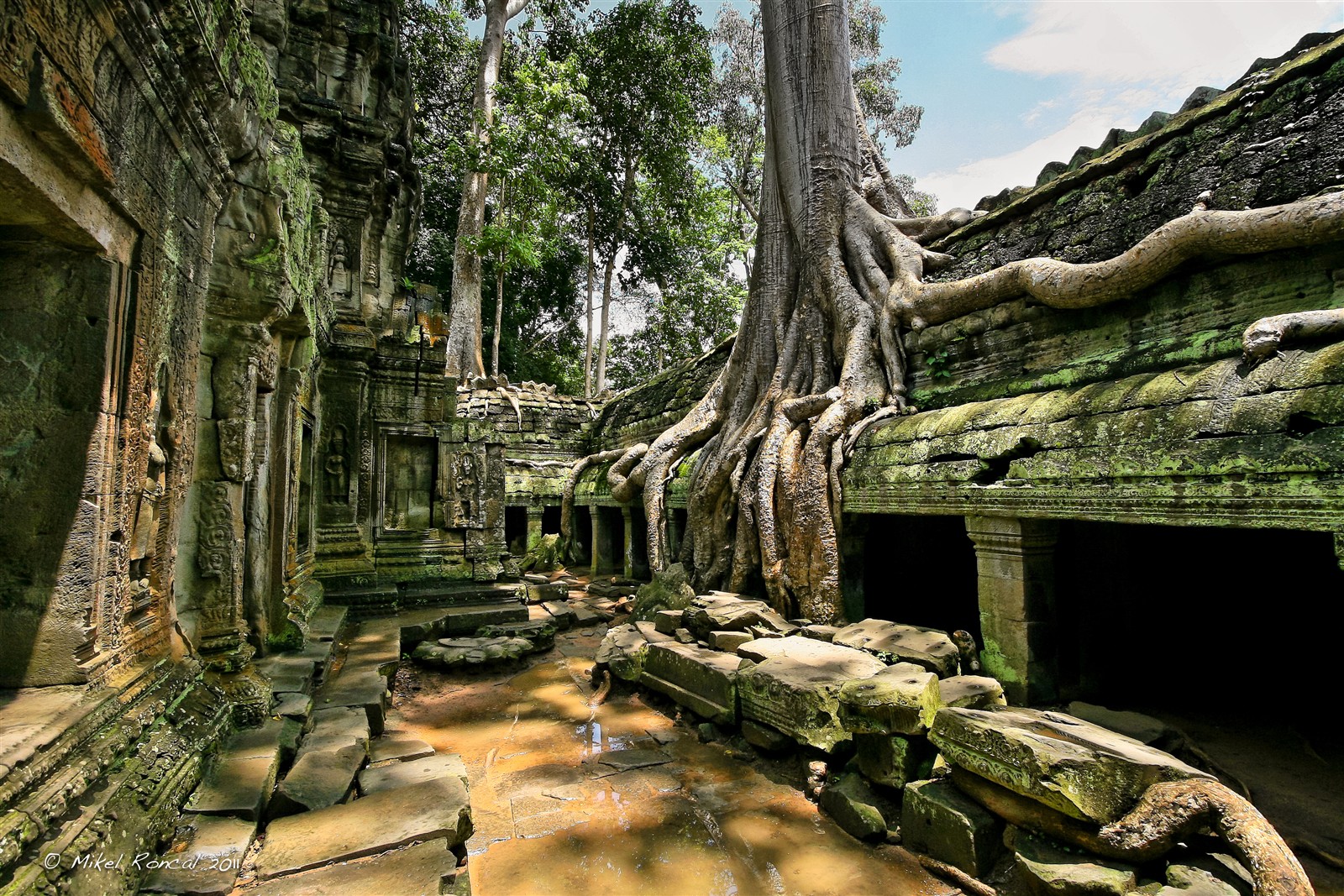
The eventual Indiana Jones fantasy, Ta Prohm is cloaked in stippled gloominess , its decomposing towers and walls locked in the sluggish , muscular embrace of large main systems. If Angkor Wat, the Bayon and other temples are witness to the brilliance of the ancient Khmers, Ta Prohm reminds people equally of the excellent fertility and influence of the forest . There is a romantic cycle to this admired , with humanity earliest conquering natural world to speedily create, and Mother Nature once again discovering humanity to unhurriedly demolish .
Built from 1186 and initially known as Rajavihara (Monastery of the King), Ta Prohm was a Buddhist temple devoted to the mother of Jayavarman VII. Ta Prohm is a temple of towers, close courtyards and narrow corridors. Very old trees tower overhead, their leaves filtering the sunlight and casting a greenish pall over the whole scene. It is the closest most of us can get to feeling the charm of the explorers of old.


Phnom Bakheng HINDU TEMPLE


Around 400m south of Angkor Thom, that hill’s primary draw is the sunset view of Angkor Wat, though this has turned into something of a festival , with hundreds of travellers jockeying for space. The temple, built by Yasovarman I (r 889–910), has five tiers with seven levels.


Preah Khan BUDDHIST TEMPLE


(Sacred Sword) The temple of Preah Khan (Sacred Sword) is one of the biggest constructions at Angkor, a maze of vaulted corridors, fine carvings and lichen-clad stonework. Constructed by Jayavarman VII, it covers a very large area, but the temple itself is within a rectangular wall of about 700m by 800m. Preah Khan is a genuine fusion temple, the eastern entrance devoted to Mahayana Buddhism, with equal-sized doors, and the other cardinal directions devoted to Shiva, Vishnu and Brahma, with successively smaller doors, emphasising the unequal nature of Hinduism.


Preah Neak Poan BUDDHIST TEMPLE


Another late-12th-century work of – no surprises here – Jayavarman VII, this little temple just east of Preah Khan has a large square pool surrounded by four smaller square pools, with a circular ‘island’ in the middle. Water once flowed from the central pond into the four peripheral pools via four ornamental spouts, in the shape of an elephant’s head, a horse’s head, a lion’s head and a human head.


Roluos Group HINDU TEMPLE


The monuments of Roluos, which served as the capital for Indravarman I (r 877–89), are among the earliest big eternal temples constructed by the Khmers and mark the dawn of Khmer classical art. Preah Ko, dedicated to Shiva, has elaborate inscriptions in Sanskrit on the doorposts of each tower and some of the best surviving examples of Angkorian plasterwork. The city’s central temple, Bakong, with its five-tier central pyramid of sandstone, is a representation of Mt Meru. Roluos is 13km southeast of Siem Reap along NH6.
Xem chi tiết ...

Thứ Sáu, 31 tháng 7, 2015

Around Angkor Thom (Part 2)


Banteay Srei HINDU TEMPLE

Deemed by many to be the jewel in the crown of Angkorian art, Banteay Srei – a Hindu temple devoted to Shiva – is cut from stone of a pinkish hue and includes many of the finest stone carving anywhere in the world . Begun in AD 967, it is one of the few temples around Angkor to be commissioned by a Brahman, not by a king, perhaps a tutor to Jayavarman V.
Banteay Srei, which is 21km northeast of Bayon and about 32km from Siem Reap, can be visited along with Kbal Spean and the Cambodia Landmine Museum.

Kbal Spean RELIGIOUS, SPIRITUAL

Kbal Spean, which is a spectacularly carved riverbed, set deep in the jungle about 50km northeast of Angkor. More commonly referred to in English as the ‘River of a Thousand Lingas’, it’s a 2km uphill walk to the carvings. From Kbal Spean, you can work your way back down to the waterfall to cool off. Carry plenty of water.
At the nearby Angkor Centre for Conservation of Biodiversity, trafficked animals are nursed back to health. Free tours generally start at 1pm from Monday to Saturday.


Phnom Kulen SACRED MOUNTAIN

The most sacred mountain in Cambodia, Phnom Kulen (487m) is where Jayavarman II proclaimed himself a devaraja (god-king) in AD 802, giving birth to Cambodia. A popular place of pilgrimage during weekends and festivals, the views it affords are absolutely incredible .
Phnom Kulen is 50km from Siem Reap and 15km from Banteay Srei. The road toll is US$20 per foreign visitor, none of which goes towards preserving the site.

Beng Mealea BUDDHIST TEMPLE

Beng Mealea (admission US$5), was built by Suryavarman II to the same floor plan as Angkor Wat, is the Titanic of temples and utterly subsumed by jungle. Nature has well and truly run riot here. Jumbled stones lie like forgotten jewels swathed in lichen, and the galleries are strangled by ivy and vines.
Beng Mealea is about 65km northeast of Siem Reap on a sealed toll road.

Koh Ker HINDU TEMPLE

(admission US$10) Abandoned to the forests of the north, Koh Ker, capital of the Angkorian empire from AD 928 to AD 944, is within day-trip distance of Siem Reap. Most of the travellers start at Prasat Krahom, where nice stone carvings grace lintels, doorposts and slender window columns. The principal monument is Mayan-looking Prasat Thom, a 55m-wide, 40m-high sandstone-faced pyramid whose seven tiers offer spectacular views across the forest. However, access to the top of Prasat Thom is currently prohibited for safety reasons.

Koh Ker is 127km northeast of Siem Reap (car hire is around US$90, 2½ hours).

HEARTBEAT OF CAMBODIA

The largest freshwater lake in Southeast Asia, Tonlé Sap, an incredible natural phenomenon that provides fish and irrigation water for half of Cambodia’s population.
The lake is linked to the Mekong at Phnom Penh by a 100km-long channel, the Tonlé Sap River. From mid-May to early October (the wet season), rains raise the level of the Mekong, backing up the Tonlé Sap River and causing it to flow northwest into the Tonlé Sap Lake. During this period, the lake swells from 2500 sq km to 13,000 sq km or more, its maximum depth increasing from about 2.2m to more than 10m. Around the start of October, while the water level of the Mekong begins to fall, the Tonlé Sap River reverses its flow, draining the waters of the lake back into the Mekong.
This incredible process makes the Tonlé Sap one of the world’s most various sources of freshwater fish and an ideal habitat for water birds.
Xem chi tiết ...

Thứ Tư, 29 tháng 7, 2015

Doan Ngo Festival

"Doan Ngo Festival”, also called “Tết giết sâu bọ” (translated as Festival for “Killing the persons’ inner insects”), is the second most significant festival (to the Lunar New Year Tet Holiday) of Vietnam.

What does these names mean?   Literally, Tet refers to festival, Doan means the start, Ngo is the seventh animal of the Chinese zodiac- the horse. Doan Ngo festival is also known as Tết sâu bọ (sâu bọ = worms, pests) or Tết tháng 5, to be celebrated on the 5th day of the 5th lunar month.

The name “Tet sau bo” derives from the fact that farmers, on this day, get rid of all pests to start growing their crops for the new season. Therefore, creatures and people must become stronger in both their health and their souls to overcome this. On this occasion, the whole family have to get up early and eat fermented sticky and fruits. The worshipping is held at noon, hour of Ngo. The tradition of eating dumplings, especially lye water dumplings, extends from the belief that the dumplings will cleanse one’s body of any unwanted “parasites”.

Two irreplaceable dishes

The two traditional types of food to be eaten on this holiday are banh u and com ruou. Banh u is pyramidal sticky rice cakes wrapped in banana leaves. They are often stuffed with beans and banana leaves’ essence, creating its dominant flavor.

Com ruou, which literally translates as “rice wine,” are little balls of fermented rice bathed in wine. Com ruou is associated with the myth telling that a long time ago, there were two orphan brothers living together in a small village. They were popular among the locals for their intelligence and kindness. Also, in that village, there were two snakes Thanh Xa and Bach Xa, which after long lives, turned into spirits.  Falling in love with the brothers, they transformed themselves into beautiful ladies to lure the men. Their desire soon became true, Thanh Xa got married the older brother and Bach Xa the younger.

They lived happily together until the men grew unhealthy each passing day, scared of daylight and lived in festering darkness. The locals suspected the presence of a bad spirit, and one day, luckily, a Taoist hermit passed by the village. After being told the affliction, he conducted some spirit type tests and found out that the men’s house had a case of the evils. Brewing a wine potion, he told the locals to feed it to the men. The brothers must eat the potion’s solids and liquids in the early morning of the next fifth day of the fifth lunar calendar.  As soon as the men tucked into their special breakfast, their wives were turned into their real appearance of snakes, before disappearing in a puff of smoke, freeing the brothers.  Since that day, people have eaten “ruou nep” on Killing the Insect Day, in the hope of driving away bad spirits.

The process of making Com ruou is not quite complicated but time-consuming.  In order to have good com ruou in Doan Ngo Festival, the famers must harvest the reaped rice from a paddy, dried and pounded carefully to keep the most nutritious part of the rice. At first, the rice is steamed twice for about 30 minutes and left for a while to get cool. After that, It is mixed with yeast, before being left for two or three days to ferment, depending on the weather.  Com ruou is eaten early on this day to fight the “worms” in one’s stomach.

Just try it, you will see that Com ruou brings you a strong and quite delicious taste. In the Vietnamese traditional concept, com ruou can kill any parasites in the body. Vietnamese people, from adults to kids, mostly like eating com ruou, yet, adults are more inclined to gain its curing effects with a grain of salt.

Up to now, besides the Lunar New Year Holiday, Doan Ngo Festival plays a significant role in every Vietnamese life for practical and holy meanings. Enjoying the atmosphere of Doan Ngo Festival, you will get to know more about its value and spirits.
Xem chi tiết ...

Chủ Nhật, 26 tháng 7, 2015

Full moon (Mid-Autumn) Festival

Tet Trung Thu, as it is known in Vietnam, or the Mid-Autumn Moon Festival as we refer to in foreign countries, is a wonderful, ancient festival that revolves around children.

Vietnam’s Mid-Autumn Moon Festival (or Full moon Festival) takes place on the full moon night (15th of the Lunar August), the most charming and picturesque night of the year. The festival involves the customs of moon contemplating, procession of star & moon - shaped lanterns, lion dance, as well as holding parties with moon cakes and fruits. Do you know why we have this special festival?

The origin…
The Festival dates back as far as 15-20,000 years ago in Southeast Asia, and is traditionally held on the 15th day of the 8th Lunar Month. Looking at the moon on this day, you will see that its orbit is at the lowest angle to the horizon, making the moon appear brighter and larger than at any other time of the year. Thus, accordingly, there came a festival with a series of entertainment activities in honor of the beautiful full moon.

There are several explanations for that phenomenon as well as the tradition of celebrating the Mid-autumn Festival. Some said that it began since the reign of King Duong Minh Hoang in China, at the beginning of the 8th century. According to ancient manuscripts, the Emperor often wished to visit the Lantern Procession


Palace on the Moon. Then, with the help of a magician, he was taken to the Moon and welcomed by a lot of beautiful fairies. He expressed his admiration for their dance, which was called Nghe Thuong Vu Y, and tried to memorize. Later, he accidentally found that there were similarities between Nghe Thuong Vu Y and Ba La Mon styles. After combining the two songs and dances styles into one, he gradually introduced it to everyone in their far ruling countries. The tradition of watching the moon, the dance and songs later became a traditional event in the Mid-Autumn celebration.

Celebration on animated  streets

The festival is very much like a combination of Halloween and Thanksgiving. On the night of Lunar August 15th, the streets are full of people buying festival stuff and wandering. Besides the assorted paper lanterns, cakes, candies, the toy animals made of rice dough, the dragon heads and faces of the Earth God made of paper are displayed everywhere in the markets. Children parade on the streets, singing and carrying colorful lanterns of different sizes and shapes, such as fishes, stars, butterflies, which spin when candles are inserted, representing the earth circling the sun. In well-off families, the mid-autumn banquet is to show up their nubile girls’ cooking abilities.


This festival is mostly geared to children, thus, to help children get ready for the Festival, parents can help them make their lanterns and costumes for the lantern procession and discuss the history and culture of Vietnam. Showing our love for our children and teaching of Vietnam's love for their children is a wonderful reason to celebrate!


One important event before and during Vietnamese Mid-Autumn Festival is lion dancing. Both non-professional and professional children groups perform dances on the streets or go to houses. If accepted by the host, "the lion" will come in and start dancing as a wish of luck.

Beside the lion dance, it is customary to offer Banh Trung Thu, boxes of moon cakes, which are traditionally very rich in taste. The cakes are filled with lotus seeds, ground beans and orange peels and have a bright yoke in the center to represent the moon.  “Banh deo” is the white cake, made of sticky rice and filled with sweet mixture of lotus seeds, pumpkin seeds or green bean. “Banh nuong” is the brown cake and has salty taste with a mixture of egg, pork fat, fried onion, peanut and lemon leaves inside. Both can be in round or square shapes.

Where in Ha Noi and Ho Chi Minh City could we join this event?Moon cakes


In Ha Noi, you can come to Ho Tay Water Park, Van Ho Exhibition Centre and Giang Vo Exhibition Centre to have musical performances for children in these two days.

In Ho Chi Minh city. Between 10th and 15th of August, Ho Chi Minh City government holds "Full Moon Festival" parties for children. Are you interested in the disadvantage children? On this occasion, the city arranges for some 5.000 children to participate in lantern processions along the main streets.

Today, the Mid-Autumn Moon Festival, together with the encouraging affection for children, promotes education, poetry, dance, arts and crafts. Most overseas Vietnamese family, though far away from their home country, would like to bring their kids back to the home country right in Full moon festival time, one amongst the most important ones in Vietnam. Otherwise, most of them hold a distant festival on their own in the country where they live to remind the kids of their origin and national culture.

Not only locals, but also foreign tourists are warmly welcomed you to join in this special festival. Surely, you will have much fun when taking part in the crowds, seeing children carrying the lanterns, eating cakes and receiving gifts of celebration during the Mid-Autumn Festival!
Xem chi tiết ...